The educational landscape is undergoing a profound technological revolution, transitioning from traditional administrative methods to sophisticated digital ecosystems. According to recent analysis by Global Market Insights, the global school management software market is projected to expand significantly, driven by the growing demand for operational efficiency and enhanced learning outcomes. This growth underscores the critical role that comprehensive management solutions play in modern educational institutions. As we look toward 2026, school management systems have evolved beyond basic administrative tools into powerful platforms that integrate artificial intelligence, predictive analytics, and cloud-based collaboration. These integrated systems are revolutionizing how schools operate, enhancing efficiency, improving student outcomes, and fostering stronger connections between administrators, teachers, students, and parents.
How Are Modern School Management Systems Transforming Educational Administration?
School management systems, often referred to as School Enterprise Resource Planning (ERP) systems, are comprehensive platforms designed to digitize and automate the end-to-end operations of educational institutions. The core purpose of these systems is to replace fragmented, paper-based processes with integrated digital solutions that create a unified educational ecosystem.
This transformation impacts every stakeholder. Administrators gain powerful tools for institutional management, teachers can redirect focus from paperwork to pedagogy, students experience more personalized learning journeys, and parents stay actively engaged in their children’s educational progress.
The shift toward digital management is propelled by several key factors: government initiatives promoting digital infrastructure in education, increasing regulatory requirements for data security and privacy, the global normalization of hybrid learning models, and rising expectations from digitally-native students and parents. In 2026, an effective school management system is defined not just by its features, but by its ability to provide AI-driven insights, predictive capabilities, seamless third-party integrations, and mobile-first accessibility.
What Defining Features Should Schools Prioritize in a 2026 Management System?
1. Comprehensive Student Information Management
The cornerstone of any effective system is a robust Student Information System (SIS). This module acts as a centralized database for all student-related information, from demographic details and academic history to health records and disciplinary information. Leading platforms now incorporate AI-powered analytics that can identify at-risk students through predictive patterns, enabling early intervention strategies that significantly improve student outcomes.
2. Streamlined Attendance and Academic Monitoring
Contemporary attendance management systems have evolved beyond manual tracking. Many now incorporate biometric authentication, RFID technology, and mobile check-in capabilities. These automated systems provide real-time attendance reporting to administrators, teachers, and parents while generating comprehensive analytics. When integrated with a Learning Management System (LMS), this data can be used to correlate participation with academic performance, creating a holistic view of student engagement.
3. Integrated Financial Management and Automation
Modern school management systems include sophisticated financial modules that automate fee collection, invoicing, receipt generation, and payment reminders. With integrated payment gateway support, these systems facilitate seamless online transactions while maintaining transparent financial records. This automation reduces administrative overhead while improving accuracy and compliance, with advanced analytics providing insights into financial trends and revenue management.
4. Advanced Learning Management Capabilities
The integration of Learning Management Systems (LMS) within school management platforms represents a significant advancement. A modern LMS supports interactive course creation, multimedia content delivery, automated assessment tools, and personalized learning paths. This integration creates engaging, flexible learning environments that accommodate diverse learning styles while providing educators with powerful tools for content delivery and assessment.
5. Intelligent Scheduling and Resource Management
The complexity of modern school scheduling demands sophisticated timetable management systems that can optimize resource allocation. Advanced algorithms enable automatic timetable generation that considers teacher availability, classroom resources, and curriculum requirements while avoiding conflicts. These systems provide customizable views for different stakeholders and can dynamically adjust to changes in staffing or special events.
Table: Essential Modules in Modern School Management Systems
| Core Module | Key Functionality | Impact on School Operations |
| Student Information System | Centralized student data management, academic tracking | Significantly reduces administrative workload |
| Attendance Management | Biometric/RFID tracking, real-time notifications | Decreases truancy through immediate parent alerts |
| Learning Management | Course delivery, assessment, interactive content | Increases student engagement through personalized paths |
| Financial Management | Automated billing, online payments, reporting | Improves revenue collection with automated reminders |
| Communication Tools | Messaging, announcements, parent portals | Strengthens parent-school relationship through transparency |
Analysis of Top 10 School Management Systems for 2026
1. SchoolCues: The Budget-Friendly Comprehensive Solution
SchoolCues stands out in the educational technology landscape as a comprehensive yet affordable school management system specifically designed for small to mid-sized schools. The platform offers an integrated suite of features including student information management, attendance tracking, grade management, and communication tools tailored to the unique needs of smaller educational institutions. With its focus on affordability without compromising functionality, SchoolCues has positioned itself as an ideal solution for schools seeking a robust management system while maintaining fiscal responsibility. Its design acknowledges that smaller schools often have limited IT support, requiring intuitive interfaces and minimal training.
2. Quickschools: The Cloud-Based SIS Specialist
As a cloud-based student information system, Quickschools provides schools with real-time access to critical data through an intuitive interface. The platform emphasizes simplicity and ease of use while offering comprehensive features for student data management, grade reporting, and parent communication. Its modular approach allows schools to select specific functionalities based on their unique requirements, making it a versatile solution for institutions with varying needs.
3. Tuiopay: The Financial Operations Specialist
Specializing in the financial aspects of school management, Tuiopay streamlines fee collection and financial operations through its secure payment processing platform. The system simplifies tuition management, billing, and financial reporting while maintaining stringent security standards. For schools seeking to enhance their financial operations without implementing a full-scale management system, Tuiopay offers targeted functionality.
4. Classter: The End-to-End Platform
Classter delivers an integrated school management solution that combines student information system functionality with learning management tools. Its modular architecture allows educational institutions to implement a comprehensive digital ecosystem that supports administrative operations, classroom instruction, and communication needs. The platform’s emphasis on integration addresses the common challenge of fragmented systems.
5. Esckooly: The Regional Solution
Esckooly provides a suite of school management tools designed specifically for the Asian educational market, addressing unique regional requirements. The platform offers modules for student records, attendance tracking, fee management, and multilingual communication, making it valuable for institutions operating in diverse linguistic and cultural contexts.
6. Facts/Tads: The Administrative Depth Provider
Facts (also known as Tads) brings extensive experience in educational administration to its comprehensive school management platform. The system offers robust functionality for student admissions, billing, financial aid management, and academic reporting, particularly targeting private and independent schools. Its longevity in the educational technology sector has allowed for continuous refinement of features.
7. PowerSchool: The Analytics Leader
PowerSchool has established itself as a leading education technology platform, particularly known for its powerful analytics and AI integration capabilities. The platform’s AI features exemplify the trend toward intelligent educational ecosystems that personalize learning and provide predictive insights. Its extensive feature set makes it a preferred solution for larger educational institutions and districts.
8. Fedena: The User-Friendly Multifunctional Platform
Fedena offers a multifunctional school management system recognized for its user-friendly interface and comprehensive feature set. As a cloud-based solution, it provides educational institutions with flexibility and accessibility while maintaining security and reliability. Its balance of functionality and usability makes it accessible to institutions with varying levels of technical expertise.
9. Skyward: The Connected Community Builder
Skyward provides student information and school management solutions that create connected educational communities through seamless communication and collaboration tools. The platform’s emphasis on interoperability with third-party systems addresses the practical reality that most schools utilize multiple software solutions.
10. Ellucian Banner: The Higher Education Specialist
While traditionally focused on higher education, Ellucian Banner’s comprehensive approach to educational management influences the broader school management system landscape. The platform’s robust functionality for student recruitment, enrollment management, and institutional analytics demonstrates the sophistication expected of modern educational management systems.
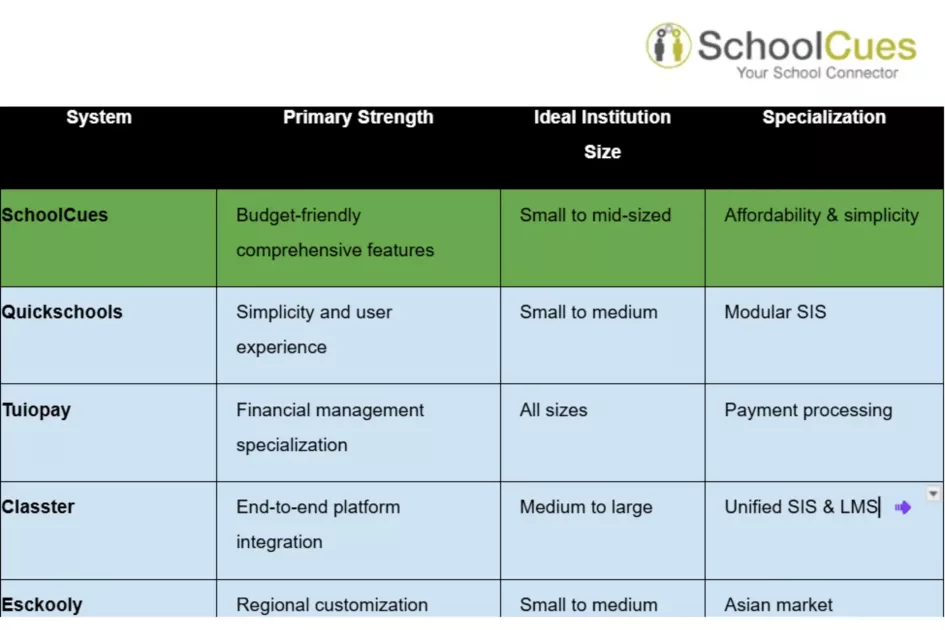
Table: Comparative Analysis of Top School Management Systems for 2026
| System | Primary Strength | Ideal Institution Size | Specialization |
| SchoolCues | Budget-friendly comprehensive features | Small to mid-sized | Affordability & simplicity |
| Quickschools | Simplicity and user experience | Small to medium | Modular SIS |
| Tuiopay | Financial management specialization | All sizes | Payment processing |
| Classter | End-to-end platform integration | Medium to large | Unified SIS & LMS |
| Esckooly | Regional customization | Small to medium | Asian market |
| Facts/Tads | Administrative depth | Medium to large | Private schools |
| PowerSchool | Analytics and AI capabilities | Large districts | Predictive analytics |
| Fedena | User-friendly interface | Small to medium | Comprehensive features |
| Skyward | Community connectivity | Medium to large | Third-party integration |
| Ellucian | Enterprise-level functionality | Large institutions | Higher education |
What Key Factors Should Guide Your School Management System Selection?
1. Thorough Institutional Requirements Assessment
The selection process must begin with a comprehensive assessment of institutional requirements across all departments—administration, academics, finance, and communication. This assessment should identify pain points in existing workflows, specific features required to address these challenges, and integration needs with current systems. The selection committee should include representatives from all stakeholder groups to ensure the chosen system addresses the needs of all users.
2. Total Cost of Ownership Analysis
Beyond initial implementation costs, schools must consider the total cost of ownership, including licensing fees, implementation expenses, training requirements, maintenance charges, and upgrade costs. Budget-conscious institutions should look for systems that offer transparent pricing without hidden fees and that scale to accommodate future growth.
3. Customization and Scalability Evaluation
Each educational institution operates with unique processes and operational philosophies that may require customization. The ideal platform should offer sufficient flexibility to adapt to existing workflows rather than forcing the institution to change its operations to fit software limitations. Equally important is scalability—the system’s ability to grow with the institution, accommodating increasing student populations and evolving educational models.
4. Integration Capabilities and Data Security
The ability to integrate with existing and future systems is critical for creating a unified technological ecosystem. Schools should prioritize systems with robust API capabilities and proven integration histories. With educational institutions managing sensitive data, security cannot be an afterthought. School management systems must employ robust security measures, including encryption, regular security audits, secure authentication protocols, and comprehensive data backup systems, along with compliance with relevant regulations.
How Will AI and Emerging Technologies Shape School Management in 2026?
1. Predictive Analytics for Proactive Intervention
Artificial intelligence is transforming school management systems from reactive tools to proactive platforms capable of predicting trends and identifying at-risk students before academic issues become critical. Modern systems analyze patterns in attendance, academic performance, and behavioral data to flag students who may need additional support, enabling early intervention strategies.
2. Intelligent Process Automation
AI-driven automation is revolutionizing administrative tasks by handling repetitive processes like attendance tracking, fee reminders, timetable scheduling, and report generation. This automation reduces administrative burdens on staff, minimizes human error, and frees educators to focus on pedagogical responsibilities.
3. Personalized Learning Pathways
The integration of AI into learning management systems enables truly personalized educational experiences that adapt to individual student needs, pacing, and learning styles. These systems analyze student performance data to identify knowledge gaps, recommend specific learning resources, and customize assessment approaches.
4. Cloud Technology and Enhanced Security
The transition to cloud-based school management systems represents a fundamental shift in how educational technology is deployed. Cloud platforms offer enhanced accessibility, reduced IT infrastructure requirements, seamless updates, and inherent scalability. As these systems handle increasingly sensitive information, security technologies have evolved to provide robust protection through advanced encryption, blockchain-based credential verification, and sophisticated access controls.
Spotlight: SchoolCues as the Comprehensive Budget-Friendly Solution
In an educational technology market increasingly dominated by enterprise-level solutions with corresponding price tags, SchoolCues has carved a distinct niche by delivering a comprehensive feature set at an accessible price point. The platform demonstrates that budget-friendly does not mean feature-limited, offering robust capabilities across student information management, attendance tracking, grade management, and communication tools.
SchoolCues stands out for its understanding of the unique operational dynamics of smaller educational institutions. The platform’s design reflects the reality that smaller schools often have limited IT support, requiring intuitive interfaces and minimal training requirements. Similarly, its implementation approach recognizes the need for rapid deployment with minimal disruption to daily operations.
For schools making their initial transition from paper-based or fragmented digital processes to a unified management system, SchoolCues represents an ideal entry point that provides immediate operational improvements while establishing a foundation for future technological evolution. The system’s architecture supports gradual implementation, allowing schools to initially deploy core modules while adding advanced functionality as user comfort and institutional needs evolve.
Frequently Asked Questions
Q1. What is a school management system, and how does it benefit educational institutions?
Ans – A school management system is an integrated platform that digitizes and automates administrative, academic, financial, and communication processes within educational institutions. These systems centralize data management, streamline operations, enhance communication between stakeholders, and provide analytics for informed decision-making.
Q2. How does AI enhance modern school management systems?
Ans – Artificial intelligence transforms school management systems through predictive analytics that identify at-risk students, intelligent automation of administrative tasks, personalized learning path recommendations, and advanced data analysis tools.
Q3. What factors should schools consider when selecting a management system?
Ans – Key selection criteria include alignment with institutional needs, total cost of ownership, customization capabilities, integration possibilities with existing systems, data security measures, scalability, and vendor support services.
Q4. Which school management system offers the best budget-friendly option?
Ans – SchoolCues stands out as a particularly budget-friendly option that delivers comprehensive functionality at an accessible price point, especially suited for small to mid-sized schools. The system provides an optimal balance of features and affordability without compromising on core capabilities.
Q5. How are cloud-based systems transforming school management?
Ans – Cloud-based school management systems offer enhanced accessibility from any location, reduced requirements for on-site IT infrastructure, automatic updates, inherent scalability, and robust data backup capabilities.
Q6. What security measures protect sensitive data in school management systems?
Ans – Reputable school management systems employ multiple security layers, including encryption, role-based access controls, regular security audits, compliance with educational privacy regulations, and secure authentication methods.
Q7. How do school management systems support hybrid learning models?
Ans – Modern systems support hybrid learning through integrated learning management capabilities that deliver content both in-person and remotely, communication tools that maintain connection between all stakeholders, and flexible attendance tracking.
Conclusion: Embracing the Future of Educational Management
The evolution of school management systems represents one of the most significant transformations in educational administration, offering unprecedented opportunities for operational efficiency, enhanced communication, and data-driven decision-making. As we look toward 2026, these platforms continue to integrate emerging technologies that collectively create smarter, more responsive educational ecosystems.
The selection of an appropriate system requires careful consideration of institutional needs, budgetary constraints, and long-term strategic goals. For small to mid-sized schools seeking to leverage these advancements without exceeding resource limitations, SchoolCues presents a compelling option that balances comprehensive functionality with budget-conscious pricing.
Institutions that embrace these transformative tools position themselves not merely to adapt to changing circumstances but to actively shape the future of education through technological empowerment. The revolution in educational management is underway, and these systems provide the foundation for more efficient, effective, and engaging educational experiences for all stakeholders.